First Academy Mass 2026–2027
Dear St. Agnes Catholic Academy Family,
Blessings!
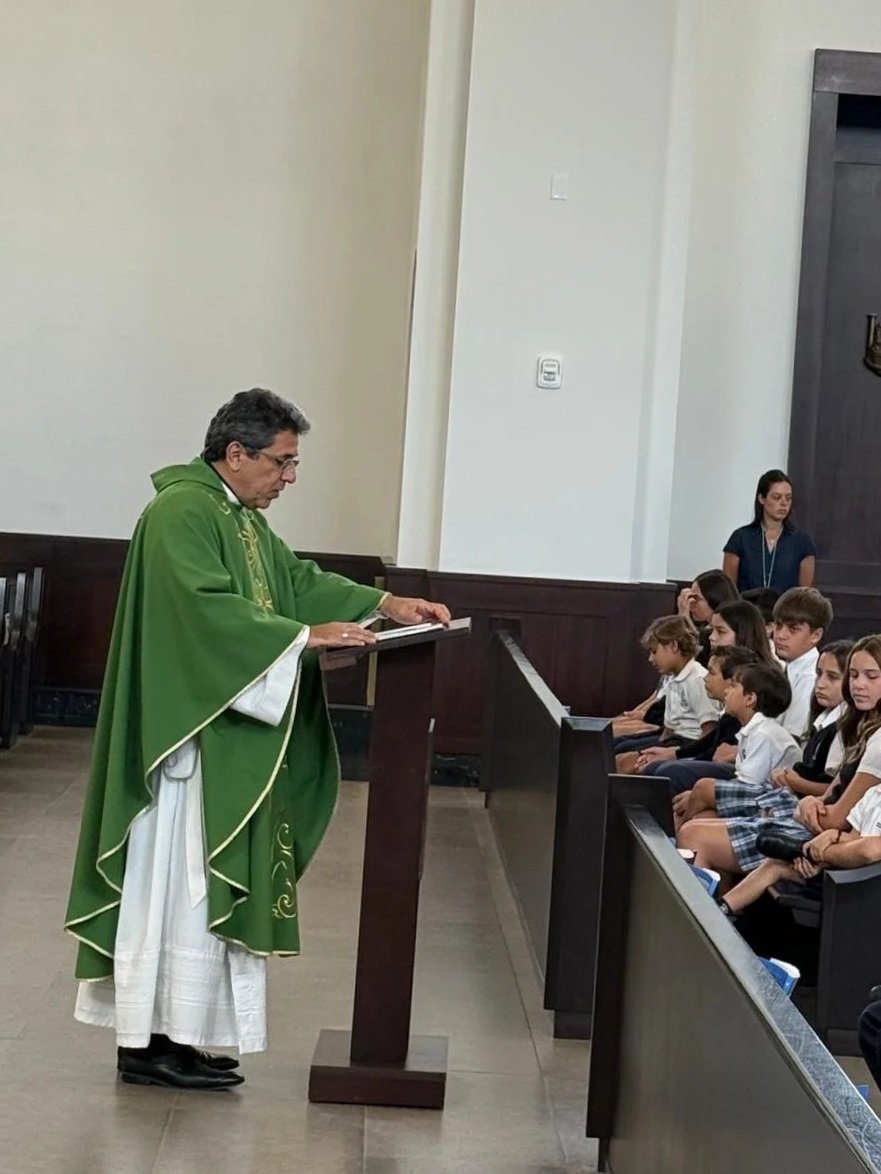
As we begin this new academic year, our first Academy Mass gives us an important opportunity to remember that we are beginning much more than another year of classes, assignments, activities, and schedules.
On the first day, our students met their teachers, found their classrooms, reconnected with friends, and began settling into their new routines.
But as I reminded them at Mass, there is something even more important that we are beginning together:
We are building a community.
And God gave us one very important word in the readings for our celebration:
Peace.
St. Paul tells us, “Have no anxiety at all.” The Psalm reminds us that “The Lord speaks of peace to his people.” And in the Gospel, Jesus teaches us what to do when difficulties arise between people.
That is an important lesson for all of us because peace does not mean that we will never have problems.
Peace does not mean that nobody will become upset, that disagreements will never happen, or that everyone will always see things the same way.
That would not be realistic.
Christian peace means that when problems come, we handle them differently because Jesus is with us.
Talking to One Another
In the Gospel, Jesus tells us:
“If your brother sins against you, go and tell him his fault between you and him alone.”
Notice what Jesus asks us to do.
He asks us to go to the person.
Talk.
Listen.
Try to understand.
Try to make peace.
This is an important lesson not only for our students, but also for teachers, staff, parents, administrators, and certainly for me as pastor.
Sometimes we can become very good at talking about people while becoming less willing to talk to people.
Jesus proposes another way.
He calls us to become people of reconciliation.
The Goal Is Not to Win
One of the most beautiful lines in the Gospel comes when Jesus says that if the other person listens to you:
“You have won over your brother.”
Jesus does not say, “You won the argument.”
He does not say, “You proved that you were right.”
He says:
“You have won your brother.”
For Jesus, the ultimate question is not, Who won?
The question is:
Did we save the relationship?
That is the kind of community I pray we continue building at St. Agnes.
When there is a disagreement, instead of asking, How can I win?, perhaps we can ask:
How can we fix this?
When somebody makes a mistake, rather than asking how we can expose or embarrass that person, perhaps we can ask:
How can I help?
When someone is sitting alone, instead of thinking, That is not my problem, perhaps we can be the person who says:
“Would you like to sit with us?”
And when we realize that we have hurt another person, may we have enough humility and courage to say:
“I am sorry.”
When someone sincerely apologizes, may we have enough love to say:
“I forgive you.”
Those words may never appear on a math test or science exam, but they are among the most important words our children can learn.
Will People Know That Jesus Is Here?
Jesus gives us another beautiful promise:
“Where two or three are gathered together in my name, there am I in the midst of them.”
Jesus wants to be present in every part of our Academy.
In our classrooms.
During math and science.
During religion and language arts.
At lunch and recess.
On the field and on the court.
In our faculty meetings and parent gatherings.
And especially during the difficult moments.
But this presents us with an important question:
Will people know that Jesus is here by the way we treat one another?
We can have crucifixes on our walls.
We can pray before class.
We can celebrate Mass.
We can teach religion.
We can call ourselves a Catholic Academy.
But perhaps the strongest evidence that Jesus is truly among us will always be the way we treat one another.
Become Part of the Solution
I gave our students a simple challenge for this school year, and I believe it is a good challenge for all of us.
Before saying something about another person, ask:
Is it true?
Is it necessary?
Is it kind?
And when a problem arises, remember what Jesus teaches us.
Go to the person.
Try to understand.
Try to make peace.
Certainly, our children should always seek the assistance of a teacher, administrator, parent, or another trusted adult whenever they need help. But the larger lesson remains important for all of us:
Do not make the problem bigger. Become part of the solution.
Let Peace Begin in Me
Our theme for this new school year is more than a slogan. It is a prayer and a responsibility.
Let peace begin.
But peace must begin somewhere.
And perhaps the best place to begin is with each one of us.
So my prayer for our Academy family this year is very simple:
Jesus, let Your peace begin in me.
Peace in my thoughts.
Peace in my words.
Peace in my classroom.
Peace in my friendships.
Peace in my family.
Peace in our Academy.
And when there is a problem, Lord, help me to become part of the solution.
At the end of this school year, if our students have learned more mathematics, science, history, language arts, technology, and all the other subjects entrusted to them, we will certainly have much to celebrate.
But if along the way they have also learned how to forgive, how to reconcile, how to respect one another, how to notice someone who is alone, and how to bring the peace of Christ wherever they go, then they will have learned something even greater.
They will have learned how to become a little more like Jesus.
Let peace begin.
And let it begin with us.
With prayers for a blessed and joyful school year,
Fr. jc